



- ホーム
- 下関市立大学について
- SDGsホーム
- 【研究成果】本学教員らの論文が国際学術誌JACIIIに掲載されました ― 同じ文学作品でも、言語が変わるとAIの感情評価はどう変わる? ―
SDGs
TOPICS
お知らせ
#教育 #研究【研究成果】本学教員らの論文が国際学術誌JACIIIに掲載されました ― 同じ文学作品でも、言語が変わるとAIの感情評価はどう変わる? ―

この度、下関市立大学データサイエンス学部の白濵成希教授らによる研究論文が、計算知能と知能情報学を扱う国際学術誌『Journal of Advanced Computational Intelligence and Intelligent Informatics(JACIII)』に掲載され、2026年11月20日に公開されました。
同じ文学作品を日本語、英語、繁体字中国語でAIに提示したとき、感情の評価は同じになるのでしょうか。本研究では6種類の大規模言語モデル(LLM)を比較し、言語条件による感情評価の変化がモデルによって異なることを明らかにしました。
研究のポイント
1.3つの言語条件で、文学作品に対する感情評価を比較
夢野久作の『懐中時計』『お金とピストル』と、高村光太郎の『ぼろぼろな駝鳥』の3作品を使用しました。6種類のLLMに日本語・英語・繁体字中国語の3条件で作品を提示し、「大学1年生」「文学研究者」「感情豊かな詩人」「無感情なロボット」という4つの読み手の役割を与えました。各条件を3回繰り返し、最終的に648件の有効な応答を分析しました。
AIには各作品について「面白さ(Interesting)」「驚き(Surprise)」「悲しみ(Sadness)」「怒り(Anger)」をそれぞれ0~100点で評価し、短い理由も示すよう求めました。
2.言語条件による評価の変化は、AIモデルごとに異なる
統計解析の結果、4つの感情すべてについて、AIモデルと言語条件の組合せによる有意な違いが確認されました。全体平均では英語条件で「面白さ」「驚き」「悲しみ」の点数が高く、日本語条件で「怒り」の点数が高い傾向が見られました。ただし、これらは全体を集計した傾向であり、個々のAIモデルに共通するものではありません。
また、どの文学作品を評価するかも重要で、特に「驚き」「悲しみ」「怒り」では作品の違いが評価に大きく関係していました。
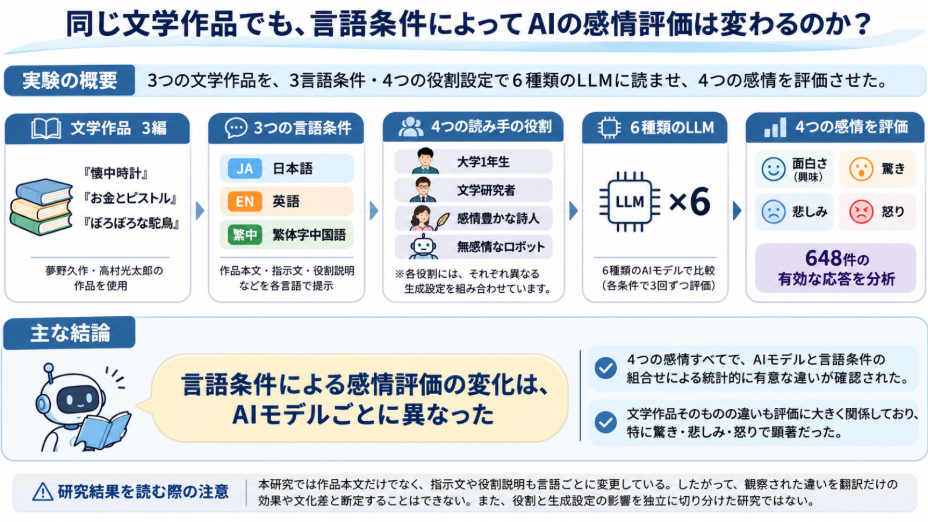
図:文学作品を用いた多言語条件下でのLLM感情評価実験の概要と主な結果。3作品、3言語条件、4つの役割設定、6種類のLLMを用い、648件の有効な応答を分析した。言語条件による評価の変化は、モデルごとに異なっていた。
研究内容の出典:Shirahama et al., JACIII, 30(6), 1866–1875 (2026). (白濵成希監修、OpenAI ChatGPTを用いて作成。)
3.「翻訳の効果」や「文化差」とは切り分けて考える
今回の言語条件では、文学作品の本文だけでなく、指示文、役割説明、作品名、著者名なども一体として各言語に切り替えています。このため、観察された違いを翻訳だけの効果や文化差と断定することはできません。また、4つの役割にはそれぞれ異なる文章生成設定が対応しており、役割と生成設定の影響を独立に切り分けた実験ではありません。
研究チームは、実験設計、応答の補完手順、分析用データ、解析コードなどを公開しており、結果を検証できるようにしています。
研究の意義と今後の展望
生成AIを多言語の対話支援や文章分析に活用する際には、モデルが異なるだけでなく、同じ内容を提示する言語条件が違うだけでも評価の傾向が変わり得ます。本研究は、AIによる感情評価の比較において、言語条件を無視できない実験要因として扱う必要性を示しました。
今後は、対象作品や言語を拡張し、人間による感情評価との比較などを通じて、AIの感情評価の妥当性と安定性をさらに検証することを目指します。
著者からのコメント
「同じ作品でも読み手によって受け止め方が異なるように、AIの感情評価にも、モデルや言語条件による違いが見られました。大切なのは、AIが人間と同じ感情を持つと考えることではなく、どの条件で評価がどう変わるのかを客観的に確かめることです。今後も、人間の感性や感情の曖昧さを踏まえ、信頼できるAI評価の研究を進めていきたいと考えています。」
論文情報
論文タイトル:Multilingual Emotion Profiling of Large Language Models Through Literary Texts and Persona Conditioning
和訳:文学作品とペルソナ条件付けによる大規模言語モデルの多言語感情プロファイリング
著者:白濵 成希(Naruki Shirahama)、吉元 裕真(Yuma Yoshimoto)、中谷 直史(Naofumi Nakaya)、渡邉 志(Satoshi Watanabe)
掲載誌:Journal of Advanced Computational Intelligence and Intelligent Informatics(JACIII)
巻号・ページ:Vol. 30, No. 6, pp. 1866–1875(2026)
採択日:2026年6月25日/公開日:2026年11月20日
DOI・論文全文: https://doi.org/10.20965/jaciii.2026.p1866
公開データ・解析コード: https://github.com/nshrhm/llm-emotion-attribution-multilingual
掲載誌『JACIII』は、Web of ScienceのEmerging Sources Citation Index(ESCI)やScopusに収録されている国際査読誌です。ジャーナルインパクトファクター(Journal Impact Factor)は0.7(2025年)です。
本研究は、日本学術振興会科学研究費助成事業(JSPS科研費、課題番号JP26K14983およびJP24K13350)の助成を一部受けて実施されました。
SHIMONOSEKI CITY UNIVERSITY | RESEARCH NEWS | ENGLISH
Research Published in JACIII: Do AI Emotion Ratings Change When the Same Literary Works Are Presented in Different Languages?
A research paper co-authored by Professor Naruki Shirahama of the Faculty of Data Science, Shimonoseki City University, has been published in the Journal of Advanced Computational Intelligence and Intelligent Informatics (JACIII). The paper was published online on November 20, 2026.
Would an AI system rate the emotions in the same literary work in the same way when it is presented in Japanese, English, or Traditional Chinese? The study compared six large language models (LLMs) and found that changes associated with the language condition differed substantially from model to model.
Research Highlights
1. Comparing literary emotion ratings across three language conditions
The researchers used three Japanese literary works: “The Pocket Watch” and “The Money and the Pistol” by Kyusaku Yumeno, and “The Tattered Ostrich” by Kotaro Takamura. Six LLMs evaluated the works under Japanese, English, and Traditional Chinese conditions. Four assigned reading personas—a first-year university student, a literary scholar, an emotionally expressive poet, and an emotionless robot—were used. Each combination was repeated three times, yielding a final analysis dataset of 648 valid responses.
For each work, the models assigned scores from 0 to 100 to four emotional dimensions—Interesting, Surprise, Sadness, and Anger—and provided short explanations for their ratings.
2. Language-related changes differed across AI models
The statistical analyses identified significant model-by-language interactions for all four emotions. In the aggregated results, English conditions had the highest average ratings for Interesting, Surprise, and Sadness, while the Japanese condition had the highest average Anger rating. These averages, however, should not be interpreted as patterns shared by every model; model-specific contrasts differed.
The choice of literary work also mattered. In particular, text identity was a major source of variation in ratings of Surprise, Sadness, and Anger.
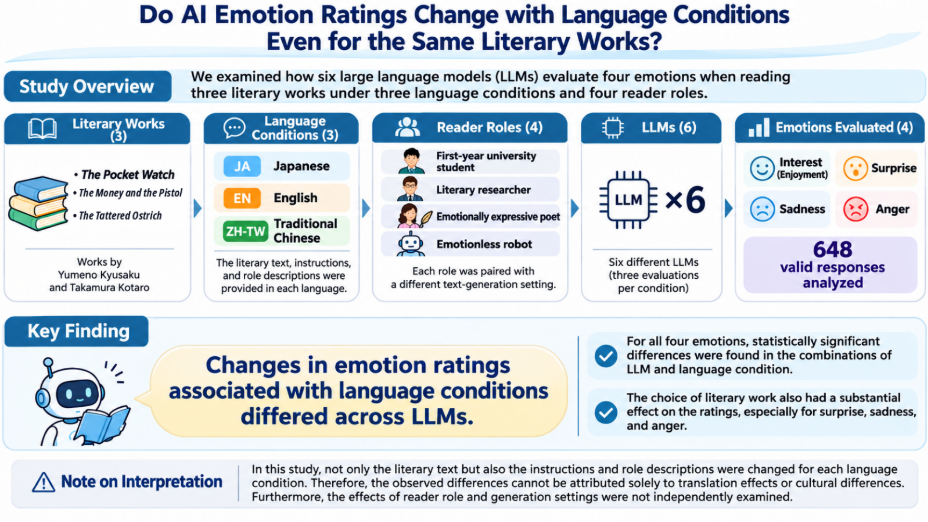
Figure: Overview of the multilingual literary emotion-rating experiment and its main finding. Six LLMs evaluated three works across three language conditions and four assigned personas, producing a final dataset of 648 valid responses. The way ratings changed across language conditions differed by model.
3. What the findings do—and do not—show
The language condition changed more than the literary text alone: instructions, persona descriptions, titles, and author names were also switched together. The results therefore do not isolate translation effects or establish cultural differences. In addition, each persona was paired with a different generation setting, so the separate effects of persona and temperature cannot be identified in this experiment.
To support reproducibility, the research team has made the study design, documented repair procedure, analysis datasets, and code available in a public repository.
Significance and Future Directions
As generative AI is used in multilingual dialogue and text analysis, it is important to determine whether emotion ratings remain consistent across models and language conditions. This study shows that language conditions should be treated as substantive factors in benchmarking LLM emotion evaluations, rather than as incidental changes in presentation.
Future work will examine a wider range of literary works and languages and compare LLM ratings with human assessments to investigate their validity and stability more thoroughly.
Comment from the Research Team
“Just as readers may interpret the same literary work differently, we observed differences in AI emotion ratings across models and language conditions. The key question is not whether AI has human-like feelings, but how its evaluations change under clearly defined conditions. We hope to continue developing rigorous ways to assess AI while respecting the complexity and ambiguity of human emotion.”
Publication Details
Title: Multilingual Emotion Profiling of Large Language Models Through Literary Texts and Persona Conditioning
Authors: Naruki Shirahama (白濵 成希), Yuma Yoshimoto (吉元 裕真), Naofumi Nakaya (中谷 直史), and Satoshi Watanabe (渡邉 志)
Journal: Journal of Advanced Computational Intelligence and Intelligent Informatics (JACIII)
Volume and pages: Vol. 30, No. 6, pp. 1866–1875 (2026)
Accepted: June 25, 2026 | Published: November 20, 2026
DOI and full text: https://doi.org/10.20965/jaciii.2026.p1866
Public data and analysis code: https://github.com/nshrhm/llm-emotion-attribution-multilingual
JACIII is a peer-reviewed international journal indexed in the Emerging Sources Citation Index (ESCI) of the Web of Science Core Collection and in Scopus. Its 2025 Journal Impact Factor is 0.7.
This work was supported in part by JSPS KAKENHI Grant Numbers JP26K14983 and JP24K13350.